

Here, you’ll understand Section 8 in a practical and straightforward way: how it works in real life, what expectations are realistic, and where to focus your efforts to achieve the best possible outcomes.
Looking for housing assistance? Learn how to locate your PHA, check the Section 8 waiting list, and avoid common mistakes.
Section 8 (Housing Choice Voucher): A general guide to paying up to 70% less in rent.
Section 8: Housing assistance program that helps low-income families and individuals pay part of their rent.
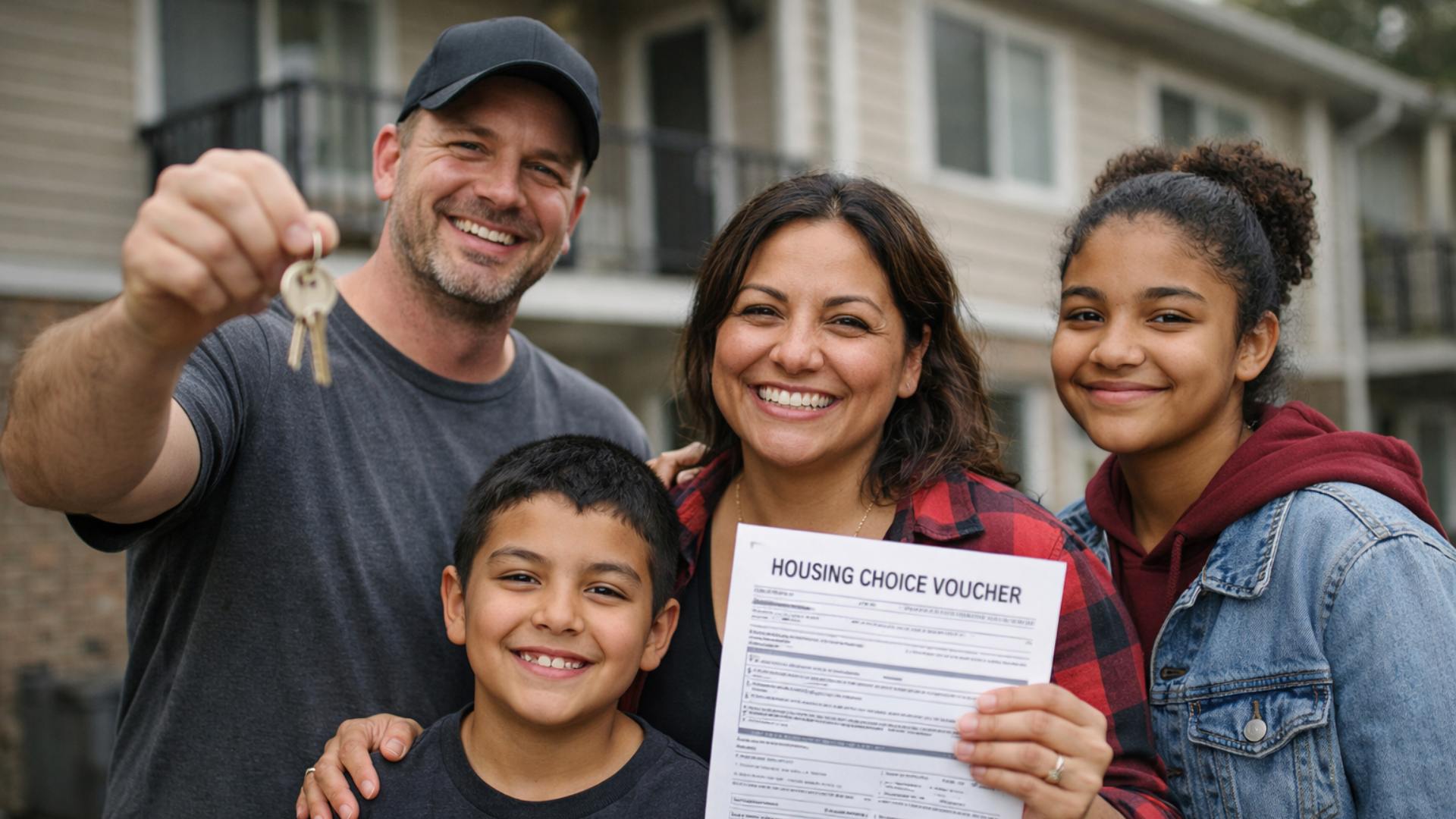
Program benefits:
You will remain in the same website
What Section 8 is and why it exists
Section 8 / HCV exists to make housing more affordable for people who, without some form of support, would struggle to maintain stable and safe housing.
The core logic is simple: instead of placing everyone in public housing, the program helps beneficiaries rent on the private market, as long as the unit and the lease meet certain requirements.
What the voucher “changes” in your rent (in general terms)
The voucher works as financial “support” for rent payments.
In many situations, the beneficiary pays a portion of the rent that is compatible with their income, and the program covers the remaining amount up to an approved limit.
This does not mean that “any rent qualifies” or that the program covers any price.
A common source of frustration is imagining the voucher as a free pass to choose any property.
In reality, there are caps, property quality standards, contract rules, and periodic inspections.
Why the rules vary depending on location
Although it is a federal program, Section 8 is administered locally by housing authorities (PHAs).
This means that details such as preferences, priorities, application methods, opening and closing of waiting lists, and even required documentation can vary.
In other words, “Section 8” is the same program by name, but the actual experience can be very different from one city to another.
Who typically qualifies and which criteria usually matter
Eligibility is generally tied to income and household composition, but that’s not all.
Each locality works with its own limits and criteria, so qualification is not a universal “yes or no.”
Income and household size
In general, the program targets low-income individuals and families.
Because acceptable income is usually calculated based on local rules and benchmarks, what seems “low” in one area may not be the same in another.
Household size also matters, as it affects income thresholds and the type of housing considered appropriate.
Status and eligibility verifications
In many cases, the eligibility process involves verifying the information provided: income, household composition, housing history, and other data.
This is not meant to “punish” applicants, but to ensure the program reaches those who truly meet the requirements.
That’s why consistency and clarity in your information are critical.
When data appears contradictory, incomplete, or outdated, the chances of delays, requests for additional information, or processing issues increase.
The waiting list: The most confusing (and most frustrating) part
If there is one topic that dominates Section 8 discussions, it’s the waiting list.
Many people assume that once they apply, they are “close,” but in reality, the wait can be long depending on the region and demand.
Why waiting lists open and close
PHAs typically open waiting lists when they can accept new applications without losing the ability to manage the flow.
When demand becomes too high, the list may close and only reopen when there is capacity to process new applicants.
This does not mean the program has ended. It means that, at that moment, the locality is controlling the intake of new requests.
Local priorities and preferences
Many PHAs apply priorities. Generally, these priorities exist to address situations of greater vulnerability first.
Details vary widely, but the key point is this: priority does not guarantee approval and does not eliminate waiting time, it may only change your relative position on the list, according to local rules.
Communication and data updates
A common mistake is assuming that once you are on the list, all you need to do is wait. In practice, waiting lists and applications may require periodic updates.
If your contact information is outdated, you risk missing important communications.
What changes after you receive the voucher
Receiving the voucher is a milestone, but it also marks the beginning of a new phase with added responsibilities.
The biggest change is entering the process of finding suitable housing, negotiating with a landlord, and complying with program requirements.
Choosing a unit: not just any property qualifies
In general, the unit must meet quality and safety standards, and the rent must fall within accepted limits.
This is often where expectations need to be adjusted: in high-cost areas, it can be more challenging to find available units within what the program allows.
Relationship with the landlord and the lease
Section 8 involves an arrangement where the landlord receives payments partly from the program and partly from the tenant, under specific rules.
Some landlords participate without hesitation; others prefer not to due to bureaucracy, timelines, or personal preferences.
This makes the search more strategic: clear communication, organized documentation, and an objective approach tend to help.
Inspections and maintaining the benefit
Generally, there are periodic inspections or checks, as well as recertifications (reviews of income and household composition).
The goal is to keep the benefit aligned with the beneficiary’s reality and with the minimum standards of the unit.
Real benefits of section 8
It’s important to talk about the benefits with realistic expectations. The program can be life-changing, but it is not instant or simple for everyone.
More predictability in the budget
For many families, the greatest gain is predictability. Instead of watching rent “eat up” their paycheck, the voucher helps balance housing costs with income, within applicable rules.
Access to the private rental market
Section 8 is not just “a place to live.” It can open access to private-market units, allowing families to seek housing that fits their routine, children’s schools, work, and support networks.
Stability and reduced risk of forced moves
When housing is unstable, families tend to move frequently, affecting employment, education, and mental health.
Section 8 can reduce this instability, although it does not eliminate all risks (such as local policy changes or shifts in the rental market).
Limits and common challenges (what many people only discover later)
Understanding the limits in advance helps avoid frustration and poor decisions.
Waiting times can be long
This is one of the hardest aspects. In many areas, demand exceeds capacity.
As a result, Section 8 often requires patience and ongoing monitoring, especially in metropolitan areas.
Not every landlord accepts vouchers
Even with a voucher, acceptance is not guaranteed.
Some of this is cultural, some relates to past experiences, and some to administrative complexity.
This requires resilience and strategy during the Search, without idealizing the process.
The voucher does not “cover everything”
In general terms, there are limits, and there may be situations where the tenant’s share is still significant.
Additionally, the program is not a substitute for basic financial planning: budgeting, documentation, and meeting deadlines are still essential.
You apply through your local Public Housing Authority (PHA). The U.S. Department of Housing and Urban Development (HUD) contact directory is a direct reference for finding the correct agency.
No. If the list is closed, you must wait for it to reopen and monitor announcements. In the meantime, prepare your information and check nearby PHAs.
In many cases, yes, and this can increase your chances due to long waiting lists. The U.S. Department of Housing and Urban Development (HUD) notes that, because of high demand, it may be necessary to apply to multiple lists.
Not always. However, some PHAs may require initial residency within the jurisdiction, so it is essential to read the local rules.
You should receive confirmation (a protocol number, email, or an “application received” screen). Without this, it is risky to assume you are on the waiting list.
Conclusion
Section 8 (Housing Choice Voucher) can be a concrete alternative for those who need more housing stability, especially when rent is consuming the basics of the household budget.
But it works best when you understand three simple truths: it is locally administered, it may involve waiting, and it has clear rules and limits.
The more realistic your expectations, the lower the risk of frustration and the greater your ability to navigate the process safely, whether you are gathering information or organizing your strategy for housing support.
Disclaimer: This content is for informational purposes only. We have no affiliation with the government, local housing authorities (PHAs), or any official agency. We do not guarantee approval, timelines, waiting list openings, or benefit availability.


